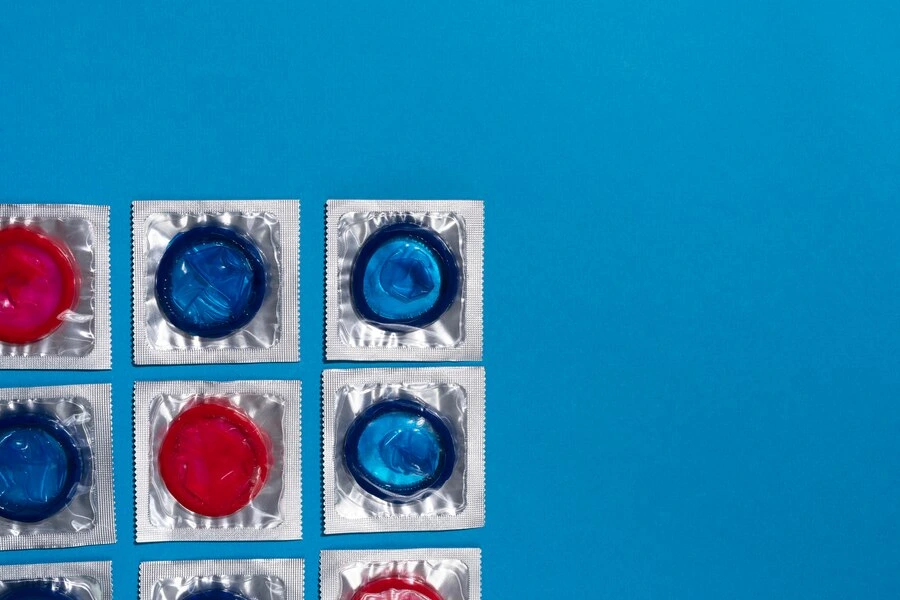
Condoms are widely promoted as offering protection against pregnancy and infections; and are increasingly used as the contraceptive of choice. But method and user failure, combined with a false sense of security leading to higher rates of intercourse with greater numbers of partners, mean that over half of girls relying on them will become pregnant over a five year period. And whilst, if used correctly, they protect against HIV and gonorrhoea, they do not offer substantial protection against the much more common Herpes, HPV or Chlamydia. The much more biblical 'saved sex' message (sex saved for a long term monogamous relationship) is much better than the 'safer sex' offered by condoms. My London medical practice has seen a huge rise in sexually transmitted infections (STIs) over the past few years. Genitourinary medicine clinics are struggling with the increasing workload and the Medical Society for the Study of Venereal Diseases is promoting training courses to help GPs cope. Despite well-funded Government initiatives, sexual health is actually declining. Condoms are considered to be 'the only products that offer protection against both pregnancy and infections '. As such, they are the major priority in most sexual health improvement strategies. Half of girls under 16 attending family planning clinics in 2000-2001 chose male condoms as their main contraception method. The proportion of those of all ages using condoms rose from 6% in 1975 to 35% in 2001; use of the contraceptive pill declined from 70% to 42%. Of course, choosing condoms does not equate with using them. A large survey found that only 40% of unmarried 18-59 year olds used them at last intercourse. Even when this contact was casual, still only 62% used them.Another study of 8,500 American undergraduates found that only 43% always used condoms and 24% never did.

I feel giving up Letitia was the best possible decision for all of us. I'm still in contact with her and with her family. I know this is unusual, but for me, it's best. Especially now, during the holiday season, I have to know what is going on with her life. People ask how I could do this, how I could give her up after being her mother for nine months. Well, I feel I was a very good mother, but I was able to put her in a home with a better atmosphere. I gave her to people who are raising her even better than I was. It was like an answer to my prayers the day my mother's friend called. I was feeling low, and I started talking to her. I was crying, and suddenly she said, "Susie, I know a family who might be interested in adopting Letitia. Let me call them and see how they feel." I told her to go ahead. Two hours later she called me back adn said,"These people want to meet you and Letitia, and they're interested in adopting her." Then she told me more about them. I had already heard of them through my Mom and Dad who knew them. They had two adopted children, five and eight years old.

I never thought I would let anybody else take care of him, but it happened. I wasn't able to give him all the things he needed, and besides, I really didn't know how to take care of him. Grant's father and I met when I was 14. We were going to gt married as soon as I turned 16. But the first time I saw him hold Grant, I thought,"He can't do that". I couldn't realize the baby was his too. From that minute I knew we would break up. So one day I said,"You know, I'm not going to marry you," and he left. Being pregnant was so neat. I remember when he would kick me and the funny feelings I'd get in my stomach -- it felt like butterflies. And sometimes when I was lying on the couch, he would turn completely over, and I could feel his heart beat. It was weird. But after he was born it was hard getting up in the middle of the night every single night. Every time he cried I picked him up, and I had trouble taking care of him without falling asleep myself. Then he'd wake up again early in the morning, and in the afternoon when I wanted to take a nap. God, I was tired!

At first I almost didn't call Pat(the agency caseworker) becaouse I thought someone from an adoption agency would want to talk to me just for my kid -- that she would try to con me into giving up my baby and signing the paper as fast as possible. I'd even heard adoption agencies reffered to as baby-stealers! But she wasn't like that at all... Pat never tried to talk me into adoption -- she just wanted to help me find out what would be best for me. You see, I tried to ignore my pregnancy for at least six months. I didn't believe it at first -- I kept going to school and ignoring the whole thing. By four months I had to admit this had happened, but i told only two friends in the next couple of months. I kept wearing my coat to school so no one else would know. I was pretty miserable. Finally my parents found out. They were really understanding -- I had thought they would kill me, but instead my mother simply said, "Well, we'll have to take you to the doctor tomorrow." At first my mother assumed I was going to keep the baby. But when I started talking to Pat, Mom apparently thought it would be better for me to give it up. She didn't say so, but I could tell by the things she said like,"What are you going to do?" and "How will you suppport it?" I was about a semester away from high school graduation and I planned to go on to college.

Beth was pregnant several years ago when she was a high school senior. When their first child Eddie was born, Beth and Scott were ready for parenthood. But before she had Eddie, Beth had another child. Here she talks about that pregnancy and the difficult decision to place him up for adoption. "It was the week after my 16th birthday that I first thought that I was pregnant. I tried to ignore the whole idea, but as time went on, I knew I was indeed pregnant. I was scared to death to say anything to anybody. I was at least four months pregnant before I even told Sam. We were still dating, but by then I knew things weren't going to work out between us. He told me I should get an abortion -- he even offered to pay for it-- but it was too late for the suction method, and besides, I just didn't feel right about that. So I wore baggy clothes and hoped no one would notice. A couple of months later -- I must have been at least 6 months pregnant -- my Mom got a good side view of me as I was going out one evening. The next morning she said,"You're pregnant, aren't you?" I said,"No." I just couldn't tell her or my father beacuase I knew it would kill them.
Maya met Terry when she was 12. They first had sex when she was 13 and Terry was 18. They didn't talk about contraception. Terry always provided condoms and after a few months Maya went down and got herself on the pill at the local health authority. Two weeks before her 16th birthday, Maya knew she was pregnant. Her period was two weeks late,so Maya went down to her local GP to confirm the bad news. "Even though I knew, when she told me I was shocked,"says Maya. But according to Maya, the worst was yet to come. The doctor was furious and refused to discuss medical options. She went on a tirade, Maya remembers, "I can't talk to you without your mother,"she said."You should have it aborted. You're too young to make decisions." Too scared t oconfide in her mother, and with no other adult to turn to, Maya broke the news to Terry. He was very suportive of what she wanted- to keep the baby. But his parents-and later Maya's mother- disagreed: she should give it up.
Sexuality is a natural part of human life that can involve physical development, emotions, attraction, relationships, and personal identity. Everyone develops at their own pace, and individual experiences and preferences may differ considerably. Understanding reproductive anatomy and sexual health helps people recognise their needs and communicate more confidently with partners and healthcare professionals. Learning about contraception can support informed decisions about pregnancy prevention, while knowledge of barrier protection can help reduce the risk of sexually transmitted infections. Consent must be freely given, clearly communicated, and respected throughout every intimate interaction. Healthy relationships also depend on trust, honest communication, and respect for personal boundaries. Online information about sexuality should be evaluated carefully, especially when medical claims or advice are presented without reliable evidence. A qualified healthcare professional can provide personalised guidance about contraception, sexual health concerns, and other medical questions. Sexuality education can also help challenge harmful stereotypes and promote respectful attitudes toward different people and relationships. Browse these resources to deepen your understanding of sexuality and develop practical knowledge for healthier relationships and personal wellbeing.